Water Freedom System vs Commercial AWG: Which Is Better in 2026?
Article 6 of 10 • Product comparison guide
Water Freedom System vs Commercial AWG: Which Is Better in 2026?
Choosing between Water Freedom System and a commercial atmospheric water generator depends on one practical question: do you want the lower-cost learning path of a DIY project, or the convenience of buying a finished appliance? Water Freedom System is marketed as a digital guide for building a system that collects moisture from air, while a commercial AWG is generally designed, assembled, and sold as an integrated physical unit.
Neither option is automatically best for every household. The DIY route may offer customization and a lower initial information cost, but it transfers engineering, assembly, maintenance, and water-safety responsibility to the buyer. The commercial route may be easier to operate, but it usually requires a higher upfront investment and may include proprietary parts or manufacturer-specific maintenance.
This comparison examines cost, installation, output, humidity dependence, electricity, filtration, maintenance, support, flexibility, and emergency usefulness. It is a category comparison rather than a claim about one specific commercial brand. Exact commercial prices and specifications vary, so verify current manufacturer information before buying.
Quick Verdict: DIY Guide or Finished AWG?
Choose Water Freedom System if you enjoy hands-on projects, want to study atmospheric water generation, and are prepared to source components and evaluate the finished system yourself.
Choose a commercial AWG if you value convenience, integrated controls, manufacturer support, and a more finished installation experience.
Both approaches remain dependent on humidity, temperature, electricity, maintenance, and appropriate water treatment. No atmospheric system should be treated as unlimited water.
What Is the Water Freedom System?
Water Freedom System is presented as a digital DIY guide centered on atmospheric water generation, often abbreviated as AWG. The proposed process uses air intake, cooling, condensation, collection, treatment, and storage. The buyer typically supplies the physical components and assembles the system according to the available instructions.
A commercial AWG, by contrast, is normally sold as a finished appliance. It may include an integrated enclosure, cooling system, fan, collection reservoir, controls, filters, sensors, and automatic shutoffs. The exact features differ by manufacturer and model.
The essential difference is responsibility. A commercial buyer pays more upfront but purchases a more integrated product. A DIY buyer may pay less to access the information but assumes more responsibility for compatibility, electrical safety, sanitation, performance, repairs, and testing.
Water Freedom System vs Commercial AWG: Side-by-Side Comparison
The table below provides a high-level comparison. It avoids assigning unverified prices or performance figures to specific manufacturers. Treat it as a decision framework rather than a product certification.
| Factor | Water Freedom System DIY Route | Commercial AWG Category |
|---|---|---|
| Product format | Digital guide and builder-sourced project. | Finished physical appliance. |
| Initial entry price | Usually lower for the guide, but hardware is additional. | Usually higher because the appliance is already assembled. |
| Assembly | Buyer sources, builds, tests, and troubleshoots. | Usually simpler setup, depending on the model. |
| Customization | Potentially high, subject to technical ability. | Limited to available manufacturer configurations. |
| Humidity dependence | High. | High; commercial design does not remove atmospheric limits. |
| Electricity | Required for active cooling, airflow, and possible pumping. | Also required for active operation. |
| Maintenance | Builder manages cleaning, filters, repairs, and testing. | Manufacturer schedule and replacement parts may apply. |
| Support | Depends on the current digital offer and seller terms. | Usually manufacturer or distributor support. |
| Best for | DIY learners, preppers, and customization-focused buyers. | Convenience-focused households and organizations. |
Water Freedom System vs Commercial AWG: Price and Value
The most common comparison mistake is placing the promotional guide price beside the full retail price of a commercial AWG. That is not an equal comparison. The DIY calculation should include the guide, components, tools, electricity, storage, treatment, maintenance, repairs, and testing.
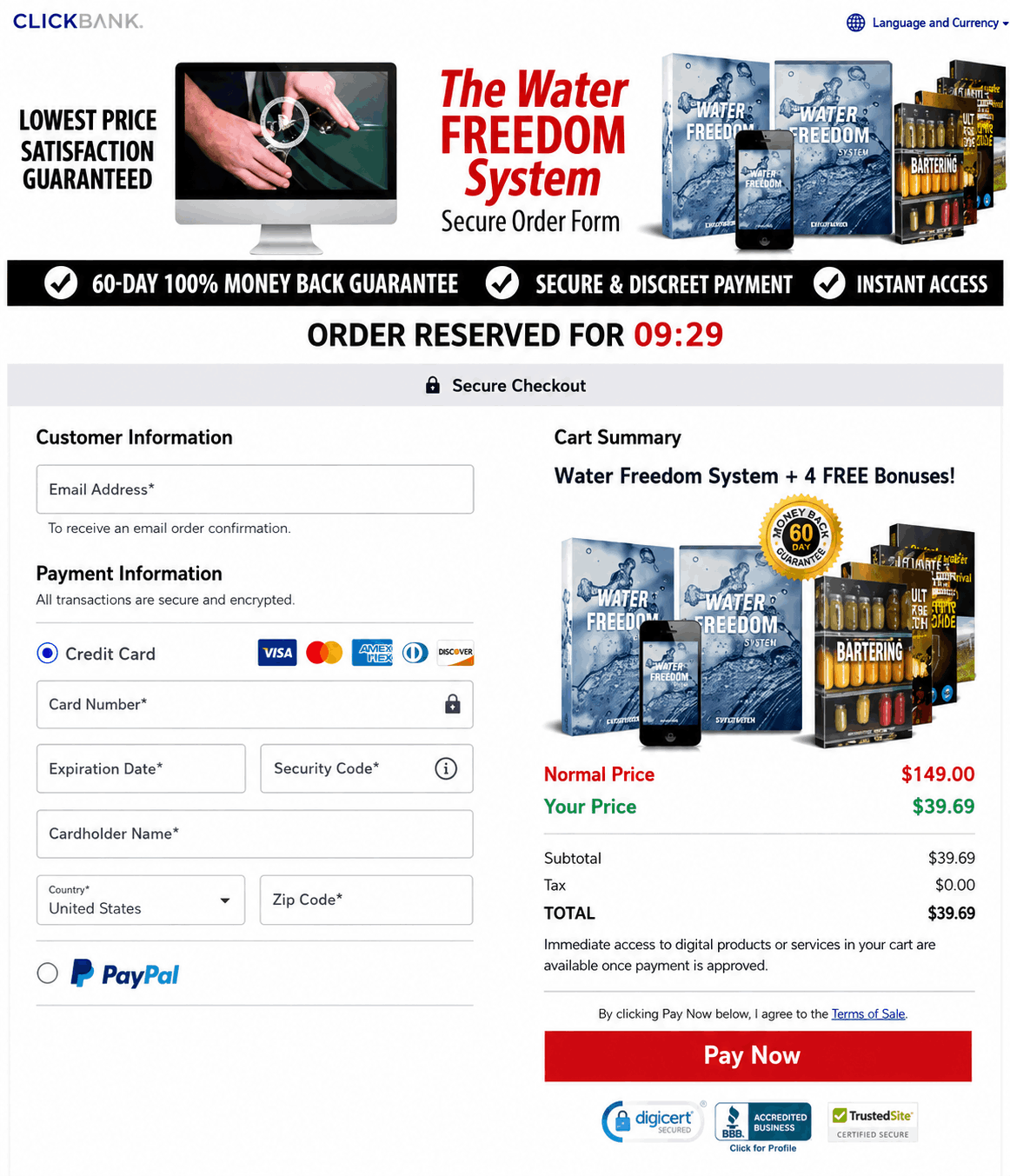
Promotional material supplied for Water Freedom System has referenced digital prices in the approximate $37–$49 range, including a figure near $39.69. Confirm the current price at checkout. The physical build may add hundreds of dollars depending on the design and what you already own.
DIY Cost Categories
- Cooling or condensation equipment.
- Fans, vents, housing, and airflow components.
- Food-safe collection surfaces and tubing.
- Reservoir, pump, tank, and storage.
- Filters, sanitation equipment, and replacement media.
- Wiring, switches, sensors, controls, and power supplies.
- Tools, insulation, fasteners, and safety equipment.
- Electricity, cleaning, maintenance, and water testing.
Commercial AWG Cost Categories
- Purchase price of the finished unit.
- Shipping, installation, or setup.
- Manufacturer-specific filters and replacement parts.
- Electricity and possible backup power.
- Cleaning, servicing, and warranty limitations.
- Water-quality verification and storage requirements.
The DIY route may have the lower total cost if you already own tools and can source reliable parts. The commercial route may provide better value if your time is limited or if professional integration is more important than customization.
Which Option Is Easier to Set Up?
A commercial AWG generally wins on setup convenience because the main cooling, airflow, collection, and control components are designed to work together. The buyer may still need to position the unit, connect power, install filters, and follow sanitation instructions, but the engineering responsibility is more centralized.
Water Freedom System may require more planning. The buyer must understand the proposed design, locate components, check dimensions, manage connections, and troubleshoot unexpected problems. A guide can make the learning process more organized, but it cannot eliminate the practical work of building.
If you enjoy technical projects, the assembly may be part of the appeal. If you want water production quickly, the DIY timeline may be frustrating. A realistic schedule should include reading, sourcing, assembly, leak checks, electrical checks, trial operation, cleaning, and water evaluation.
DIY Setup Advantage
You may customize the design, source components locally, and learn how each part works.
DIY Setup Disadvantage
Compatibility, wiring, cooling, leaks, noise, sanitation, and troubleshooting remain your responsibility.
Commercial Setup Advantage
Integrated components may reduce assembly time and simplify the user experience.
Commercial Setup Disadvantage
You may have less flexibility and greater dependence on proprietary parts or manufacturer support.
Output Comparison: Does Commercial Mean More Water?
A commercial unit may be engineered more efficiently than an improvised build, but commercial design does not remove the basic atmospheric limitation. Both systems need sufficient moisture in the air.
Output depends on relative humidity, temperature, dew point, airflow, cooling capacity, operating time, heat removal, filter condition, and storage capacity. A commercial system may provide more predictable performance under its specified conditions, while a DIY system may vary more depending on component selection and assembly.
Be cautious with any “up to” number. A maximum figure is not the same as an average daily result. Before relying on either option, look for test conditions and measure the system in your own environment.
| Variable | Effect on Output | DIY Versus Commercial Consideration |
|---|---|---|
| Relative humidity | More moisture generally means more collection potential. | Both remain dependent on local air conditions. |
| Temperature | Warm air can hold more vapor than cold air. | Commercial controls may manage operation more consistently. |
| Cooling capacity | Determines whether the system can reach the dew point effectively. | DIY sizing is the builder’s responsibility. |
| Airflow | Controls how much moisture-laden air reaches the cold surface. | Commercial systems may have engineered airflow paths. |
| Operating time | Longer runtime may increase collection but also increases power use. | Automation can be more integrated in commercial models. |
| Maintenance | Dirty filters and coils can reduce performance. | Both require cleaning and replacement schedules. |
Explore the Water Freedom System approach before choosing your setup.
Water Treatment and Safety Comparison
This category requires careful wording. Neither a DIY guide nor a commercial label automatically proves that water is safe for every purpose. Water quality depends on the collection path, materials, airborne contaminants, storage, filtration, sanitation, maintenance, and appropriate testing.
Water Freedom System Safety Responsibility
With a DIY project, the builder selects the collection materials, tubing, tank, filters, and sanitation components. The builder must also decide how to clean and test the system. That flexibility can be valuable, but it increases responsibility.
Commercial AWG Safety Responsibility
A commercial unit may include an integrated treatment pathway, filter-change indicators, UV components, or manufacturer instructions. Those features can simplify operation, but they do not remove the need to follow the maintenance schedule or verify claims relevant to your intended use.
If the water will be consumed, consult a qualified water-quality professional about suitable materials, treatment, sanitation, storage, and laboratory testing. Keep an existing safe water supply available while evaluating a new system.
Maintenance and Long-Term Ownership
A commercial AWG may be easier to maintain because its components and service procedures are designed as one product. It may still require filter changes, cleaning, UV replacement, software or sensor checks, and occasional professional service.
Water Freedom System gives the owner more control over the design, but maintenance may be less predictable. The owner has to identify which parts need cleaning, when filters need replacing, how to inspect the collection path, and how to repair or replace components.
| Maintenance Area | DIY Guide Route | Commercial AWG Route |
|---|---|---|
| Filter replacement | Builder selects and schedules replacement parts. | Manufacturer may specify compatible filters and intervals. |
| Reservoir cleaning | Owner designs and maintains the storage path. | Instructions may be more standardized. |
| Mechanical repairs | Owner or hired technician diagnoses the system. | Warranty or service network may be available. |
| Parts availability | Potentially flexible if compatible parts can be sourced. | May depend on proprietary or approved parts. |
| Documentation | Depends on the guide and the builder’s records. | Usually supplied by the manufacturer. |
Who Should Choose Water Freedom System?
Water Freedom System may be the better choice for someone who values learning and customization more than immediate convenience. It may suit a homeowner who already has tools, enjoys practical projects, and wants to understand the equipment rather than simply operate it.
- DIY enthusiasts and technical hobbyists.
- Preppers and homesteaders.
- Buyers who want to investigate atmospheric water generation.
- People in humid or moderately humid regions.
- Households comfortable budgeting for treatment and maintenance.
- Buyers seeking a supplemental, not guaranteed primary, water source.
The strongest reason to choose the guide is not the largest output claim. It is the opportunity to study and build around a real technology.
Who Should Choose a Commercial AWG?
A commercial AWG may be better for someone who wants an integrated appliance, has limited time, prefers manufacturer documentation, or does not want to troubleshoot cooling and electrical components.
- Households prioritizing convenience.
- Businesses or facilities that need a more standardized installation.
- Users who prefer manufacturer support and warranty channels.
- People who do not want to source individual parts.
- Buyers willing to pay more for an integrated system.
A commercial unit is not automatically maintenance-free or climate-independent. It remains important to check humidity requirements, electricity use, filtration, warranty limits, and replacement-part costs.
Water Freedom System vs Commercial AWG: Pros and Cons
| Water Freedom System Pros | Water Freedom System Cons |
|---|---|
| Lower initial information cost. | Physical hardware is generally additional. |
| Potentially customizable design. | Assembly and troubleshooting are the buyer’s responsibility. |
| Useful educational experience. | Output can vary significantly by climate. |
| May be repairable with commonly sourced parts. | Water safety depends on the builder’s choices and testing. |
| Commercial AWG Pros | Commercial AWG Cons |
|---|---|
| Finished product with integrated components. | Higher upfront purchase price. |
| Usually simpler user experience. | Potentially expensive proprietary filters or repairs. |
| Manufacturer documentation and support may be available. | Customization may be limited. |
| More standardized controls and enclosure. | Still dependent on humidity, electricity, and maintenance. |
What About Water Freedom System Alternatives?
If neither option seems ideal, consider whether your goal is water storage, water treatment, water creation, or emergency redundancy. Different problems require different tools.
| Alternative | Best Use | Main Limitation |
|---|---|---|
| Stored water | Immediate emergency reserve. | Requires space, rotation, and replacement. |
| Rainwater harvesting | Homes with suitable rainfall and collection space. | Dependent on precipitation and local regulations. |
| Reverse osmosis | Treating an existing water source. | Does not generate water independently. |
| Professional filtration | Improving an existing supply. | Requires a dependable source to treat. |
| Commercial AWG | Users wanting an integrated appliance. | Higher cost and continued energy use. |
Frequently Asked Questions About Water Freedom System vs Commercial AWG
Is Water Freedom System cheaper than a commercial AWG?
The digital guide has a lower entry price, but a complete DIY build requires separate hardware, tools, treatment, electricity, maintenance, storage, and testing. Compare total project costs rather than guide price alone.
Is a commercial atmospheric water generator better?
It may be better for convenience, integrated components, and manufacturer support. It may not be better for a buyer who values customization, learning, repairability, or a lower entry cost.
Does a commercial AWG work in any climate?
Commercial equipment remains dependent on atmospheric moisture. Output may decline in dry or cold conditions, even if the machine is more efficient than a DIY build.
Does Water Freedom System include a finished machine?
The supplied descriptions present it as a digital guide. Confirm the current offer, but do not assume physical equipment is included unless clearly stated.
Which option uses less electricity?
That depends on the exact equipment, humidity, temperature, cooling method, airflow, runtime, and maintenance. Require measured energy data before making a comparison.
Which option produces safer drinking water?
Safety depends on the entire collection and treatment pathway. A commercial design may provide more standardized components, but neither option should be considered safe without proper maintenance and appropriate verification.
Is the DIY route suitable for beginners?
It may be suitable for a beginner willing to learn, but cooling, electrical, plumbing, sanitation, and water-quality tasks may require qualified help.
Can I use solar power with Water Freedom System?
Potentially, but the solar system must be sized for actual power consumption, operating hours, startup loads, battery capacity, inverter efficiency, and seasonal sunlight.
Should I buy a DIY guide or store emergency water?
These solve different problems. Stored water provides immediate backup, while a DIY system may become a supplemental source after construction and testing. A resilient plan may use both.
Final Verdict: Which Option Is Better?
Water Freedom System is the better fit for a buyer who wants to learn, build, customize, and accept responsibility for the finished system. Its lower guide price can make atmospheric water generation easier to investigate, but the complete project is not necessarily inexpensive.
A commercial AWG is the better fit for someone who values a finished appliance, simpler setup, manufacturer documentation, and a more integrated user experience. The higher purchase price may be justified when time, convenience, and support matter more than hands-on customization.
Both choices need humidity, electricity, maintenance, and responsible water treatment. Neither should be marketed to yourself as unlimited or free water. The right decision depends on your local climate, expected water demand, technical ability, budget, and tolerance for maintenance.
Free Comparison Checklist
- Do I want a project or a finished appliance?
- Have I compared complete ownership costs?
- Have I checked local humidity and temperature?
- How much water do I realistically need?
- What will electricity cost per usable gallon?
- Who will clean, repair, and maintain the system?
- How will I verify water quality?
- What happens if the system stops during an outage?
- Do I have stored water or another backup source?